
Westinghouse's eVinci Microreactor
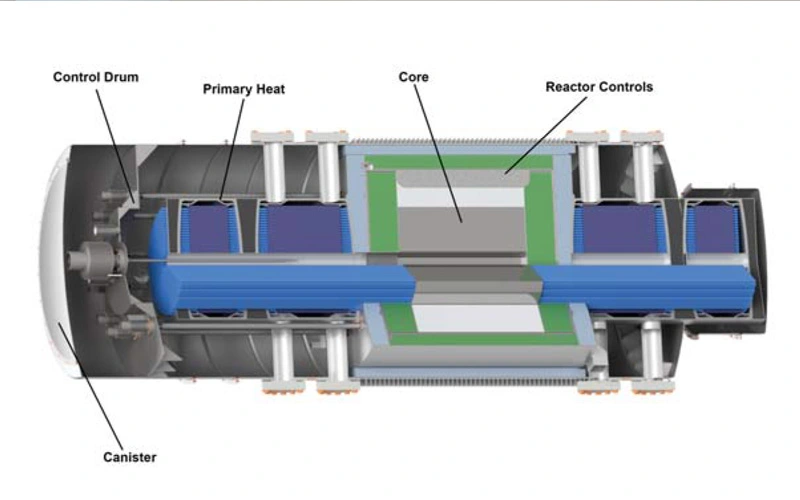
The U.S. Department of Energy (DOE) recently awarded Westinghouse $ $12.9 million in funding to develop the eVinci microreactor using sodium heat pipe technology. Westinghouse aims to design, test, fabricate and install a demonstration reactor by 2022. The company is currently developing an electrical test unit and plans to demonstrate its capabilities by 2020. The advanced heat pipe design will simplify the plant structure and reduce the number of moving parts, creating significant cost and safety benefits. The compact design also requires a small footprint for the installation, opening up new opportunities for location closer to industrial facilities and population centers. Westinghouse is in dialogue with U.S. and Canadian nuclear regulators and aims to license the design for commercial deployment by 2025 after a successful testing phase. This would put Westinghouse at the forefront of the race to commercialize microreactors.
The eVinci microreactor is a high-temperature heat pipe reactor. It consists of a rigid monolithic block with three types of channels that contain fuel, neutron moderators and heat pipes. There are no moving or mechanical parts, except for a radial neutron reflector surrounding the monolithic block that supports the nuclear reaction and allows for completely passive control in the event of power or load loss. eVinci will be delivered as a cogeneration with a power range from 200 kVe to 5 MWe, and the installation time on site will be less than 30 days.
